
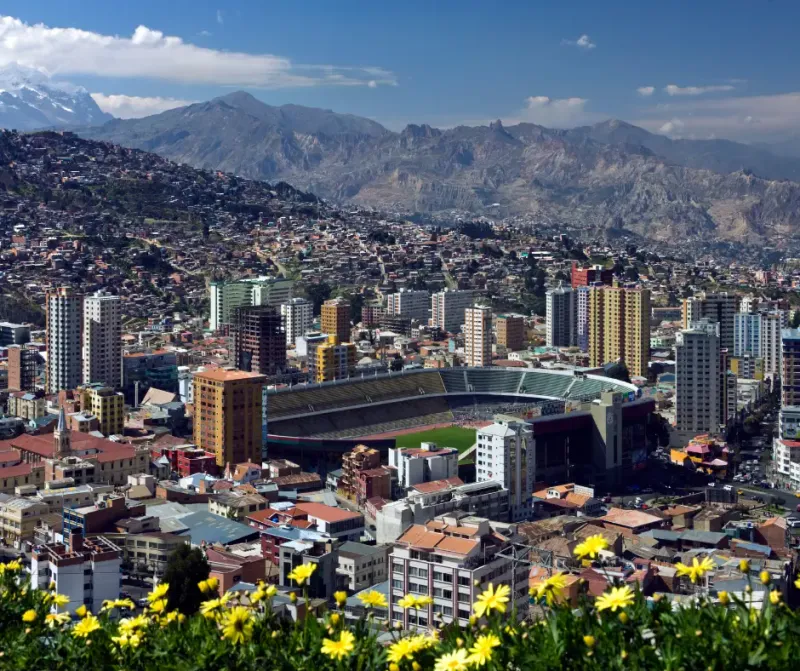
Bolivia has the world's largest salt flat, the highest capital city on the planet, pink river dolphins, and prices that make everywhere else in South America look expensive. It is also the least visited country on the continent, which is part of its appeal.
There is a reason to read carefully before you book. Bolivia is going through its worst economic crisis in a generation: fuel shortages, road blockades, the highest inflation in about forty years, and a currency that was floated in mid-2026 after fifteen years pegged to the dollar.
None of that makes Bolivia unvisitable. Many people are there right now, working, and having a very good time on a very small budget. But it does mean the practical advice written even a year ago is out of date, and that the way you pay for things has fundamentally changed.
🌱 Travel health insurance for Bolivia
🎯 Bolivia at a glance
| 🛂 Visa | Visa-free for most nationalities, including the US, UK and EU since Dec 2025 |
| 📋 Pre-registration | SIGEMIG is mandatory for every visitor, whatever your nationality |
| 💻 Nomad visa | None. Tourist entry and extensions are the only route |
| 💶 Monthly budget | €500 in Sucre to €1,000 in Santa Cruz |
| 💱 Money | Currency floated mid-2026. Bolivia runs on QR payments, cash is scarce |
| 🌤 Best time | May to October, the dry season |
| 🏙 Top areas | La Paz, Santa Cruz de la Sierra, Sucre, Cochabamba |
| 🛜 Internet | Around 54 Mbps fixed median. Fine in cities, patchy elsewhere |
| ⛰️ Altitude | La Paz sits at 3,640m. Plan your first days around it |
| ⚠️ Situation | Fuel shortages, periodic road blockades, high inflation |
🛂 Entry requirements for Bolivia
Two things changed recently:
- Visa-free access widened on 1 December 2025. The United States, United Kingdom and all EU member states were added to the visa-free list, ending the $160 reciprocity fee US citizens had paid for decades. Canada, Australia, New Zealand, Japan, South Korea and most Latin American countries are also visa-free.
- SIGEMIG registration is now mandatory for everyone. The Sistema de Gestión Migratoria is a free online pre-registration that every foreign visitor must complete regardless of nationality, and it is separate from any visa. It takes about ten minutes, opens 30 days before travel, and sends you a QR code by email that you show at the border. Turning up without it causes problems.
Everything else:
- Length of stay: 30 days on arrival for most nationalities, extendable at an immigration office in La Paz, Santa Cruz or Sucre before your current permission expires. Sources differ on the annual cap, with some saying 90 days total per calendar year and others 180. Confirm at the immigration office rather than relying on any article.
- Passport: valid for at least six months.
- Onward ticket: frequently requested at the border.
- Entry slip: you get a small white paper slip stapled into your passport. Guard it. You need it to leave or extend.
- Covid requirements: all lifted in June 2024. If a site still lists vaccination certificates or PCR tests, it has not been updated.
- Yellow fever: recommended if you are heading to the lowlands, the Amazon basin or Rurrenabaque, and some onward countries will ask for the certificate.
💻 Does Bolivia have a digital nomad visa?
No. Bolivia has no remote work visa, and none has been announced.
What exists is the tourist route: 30 days visa-free, extendable in person. For most people that is enough, and it is why Bolivia tends to be a stop on a longer South American trip rather than a base.
If you want to stay longer term, the options are a visa de objeto determinado for specific purposes, or residency through investment, employment or family ties. Both mean paperwork in Bolivia and, realistically, a local lawyer.
 Sarah Kuhlemann
 Sarah Kuhlemann
💸 Money in Bolivia, and why this matters
This is the part that has changed most, and getting it wrong will cost you time and money.
- The currency was floated in mid-2026. For fifteen years the boliviano was pegged at 6.96 to the dollar, and a large parallel market developed as dollars became scarce. The float largely closed the gap between the official and street rates, which means the old advice, bring crisp dollar bills and hunt for exchange houses, no longer applies.
- Bolivia runs on QR. Local QR payments are how the country actually pays, in markets, cafés, small shops and on tourist routes. The problem for visitors is access rather than availability: most Bolivian wallet and banking apps expect resident identity documents, and foreign bank apps generally cannot scan the local QR codes.
- Cash is genuinely scarce. ATMs ration withdrawals, cap low, or sit empty, especially outside the big cities. Most Bolivian bank ATMs do not charge foreign card fees, which is the good news, but your own bank's charges still apply and you may walk to three machines before finding one with money.
- The practical approach: treat cash as your primary method but carry more than feels comfortable, withdraw when you find a working machine rather than when you need money, and keep small denominations because change is often unavailable. Cards work in mid-range hotels and restaurants in cities and almost nowhere else.
- Inflation is high, running at the worst levels in about four decades. Any price in this guide, or anywhere else, should be treated as a rough guide rather than a quote.
✈️ How to get to Bolivia
- Viru Viru International (VVI) in Santa Cruz is the main international gateway and the easiest arrival, at only 400m above sea level.
- El Alto International (LPB) serves La Paz and sits at 4,150m, which is the highest international airport in the world. Arriving here means altitude from the moment you land.
- Jorge Wilstermann (CBB) in Cochabamba handles regional flights.
- Overland: buses connect from Peru (Copacabana and Lake Titicaca), Chile, Argentina and Brazil. Border crossings are straightforward but slow.
- A warning about overland travel right now: fuel shortages have left a large share of the country's trucks and buses idle at times during 2026, and road blockades have closed major routes for extended periods. Check the current situation before committing to a long bus journey.
🗺 Where to base yourself
La Paz is the highest capital in the world at 3,640m, built into a canyon with El Alto spreading across the plateau above it. The cable car network doubles as public transport and is genuinely one of the best commutes anywhere. Sopocachi is the neighborhood most visitors settle in: leafy, walkable, full of cafés and restaurants, and where the coworking spaces are. Budget several days to acclimatize before you try to do anything demanding.
Santa Cruz de la Sierra is the practical choice. It sits at 400m, so no altitude, it is Bolivia's economic center, it has the best flight connections and the most reliable infrastructure, and it feels more like lowland South America than the Andean image of Bolivia. Equipetrol is the modern district with the restaurants and coworking. It is also the most expensive city in the country and not especially beautiful.
Sucre is the constitutional capital and the prettiest city in Bolivia, a white colonial UNESCO town at a comfortable 2,800m. It is cheap even by Bolivian standards, has a large Spanish-language school scene that brings in a steady flow of foreigners, and a mild climate year-round. Infrastructure is thinner than La Paz or Santa Cruz.
Cochabamba sits between the two at 2,550m, known for having the best food in Bolivia and a spring-like climate. It is a real city rather than a tourist one, which is either the appeal or the problem.
Samaipata is the wildcard: a small mountain village three hours from Santa Cruz at 1,650m, with a long-standing international community of people who came for a week and stayed. Good internet for its size, and a genuine alternative if you want somewhere quiet.
💶 How much does it cost?
| Per month | Sucre | Cochabamba | La Paz | Santa Cruz |
|---|---|---|---|---|
| Room or 1BR | €150–280 | €180–300 | €200–350 | €250–450 |
| Coworking | €50–90 | €50–90 | €60–110 | €70–130 |
| Food | €150–220 | €160–240 | €170–260 | €200–300 |
| Transport | €15–30 | €20–35 | €20–40 | €25–50 |
| Realistic total | €500–750 | €550–800 | €600–900 | €700–1,000 |
Bolivia is the cheapest country in South America by a clear margin. An almuerzo, the set lunch that most of the country eats, costs around €2 to €4. A long-distance bus across the country costs less than a taxi ride in Europe. A coworking day pass is a few euros.
Treat these figures as indicative. Inflation is at its highest in four decades, and prices are moving quickly. Check current numbers before budgeting.
🧑🏻💻 Where to work from
La Paz
- Cowork Sopocachi on Gregorio Reynolds: private offices and shared desks, fast and stable internet at around 85 Mbps, close to the cable car, and responsive on WhatsApp. Weekdays 08:30 to 18:30, closed weekends.
- Squemas Cowork on Macario Pinilla: central, quiet, with coffee and printing included, and a four-hour rate if you only need part of a day. Weekdays 09:00 to 21:00.
Santa Cruz de la Sierra
- COWORK Talent Hub in Equipetrol: excellent natural light, daily passes, fast internet and comfortable chairs, in the best neighborhood in the city. Weekdays 08:30 to 19:00 and Saturday mornings.
- Central 43 on Avenida Barrientos: a collaborative space with a ground-floor open area, private corners and meeting rooms, and a genuine cultural program including exhibitions and events.
Sucre and other places
Coworking thins out quickly outside the two main cities. Sucre has a small scene, mostly attached to Spanish schools and hostels, and in Cochabamba, Samaipata or anywhere smaller you will be working from your accommodation or a café. Check for backup power and ask about internet access before booking anything long-term.
👥 Finding the community
Be realistic: Bolivia is not a nomad destination in the way Colombia or Brazil is, and the community is small. Most foreigners you meet will be travelers passing through, Spanish students in Sucre, or long-term residents rather than remote workers.
That is not entirely a downside. It means Bolivia is one of the few countries left where you will spend your time with Bolivians rather than other nomads. But if community is your priority, this is not the place to base yourself for six months.
The coworking spaces in La Paz and Santa Cruz are the best entry points. Facebook groups for expats in each city are more active than any nomad-specific channel.
🛜 Internet and SIM cards
Fixed broadband runs around 54 Mbps median, which is fine for calls and normal work in the cities and noticeably slower than neighboring countries. Outside La Paz, Santa Cruz, Cochabamba and Sucre it drops off quickly.
Entel, Tigo and Viva are the operators. Entel has the widest coverage in rural areas. A SIM costs a few bolivianos from a shop or pharmacy, and prepaid data is cheap. Bring your passport to register it.
Power cuts happen. If your work depends on being online at fixed times, choose accommodation and workspaces with backup power and always carry a phone with data as a hotspot.
🌤 When to come
| J | F | M | A | M | J | J | A | S | O | N | D | |
|---|---|---|---|---|---|---|---|---|---|---|---|---|
| La Paz & highlands | 🌧 | 🌧 | 🌧 | ⛅ | ☀️ | ☀️ | ☀️ | ☀️ | ☀️ | ☀️ | ⛅ | 🌧 |
| Sucre & Cochabamba | 🌧 | 🌧 | ⛅ | ☀️ | ☀️ | ☀️ | ☀️ | ☀️ | ☀️ | ☀️ | ⛅ | ⛅ |
| Santa Cruz & lowlands | 🌧 | 🌧 | 🌧 | ⛅ | ☀️ | ☀️ | ☀️ | ☀️ | ⛅ | ⛅ | 🌧 | 🌧 |
| Uyuni salt flats | 🌧 | 🌧 | 🌧 | ⛅ | ☀️ | ☀️ | ☀️ | ☀️ | ☀️ | ☀️ | ⛅ | 🌧 |
☀️ best time · ⛅ mixed · 🌧 wet
The dry season, May to October, is the straightforward answer, and June to August is coldest at altitude with clear skies and freezing nights.
Uyuni is the exception worth planning around. The dry season is when you can drive across the whole salt flat and reach the islands and the far corners. The wet season, roughly December to March, is when a few centimeters of water turn the flat into the mirror you have seen in photographs. Both are worth doing; they are simply different trips.
🚌 Getting around
- Buses are the backbone: cheap, extensive, and slow. Overnight routes between major cities are standard, and the better companies are genuinely comfortable.
- Fuel shortages have disrupted this in 2026. Long-distance services have been canceled or delayed, and road blockades have closed major routes for weeks at a time. Check before you travel and build in slack.
- Domestic flights with BoA and Amaszonas are inexpensive and save enormous amounts of time in a country this mountainous. Worth the money.
- La Paz cable cars (Mi Teleférico) are the world's largest urban cable car network, cost a few bolivianos, and are the best way to move around the city.
- Taxis and ride-hailing: use radio taxis or apps rather than hailing on the street, particularly in La Paz.
- Trains are limited, but the Oruro to Uyuni route is a pleasant journey.
🚧 Safety and health
- Altitude is the real risk. La Paz is 3,640m and El Alto airport 4,150m. Altitude sickness affects fit people and unfit people alike. Take your first two days slowly, drink water, skip alcohol, and consider coca tea, which is what Bolivians use. If you can, fly into Santa Cruz and travel up gradually.
- Political instability: road blockades are a normal form of protest in Bolivia and have been frequent during the current crisis, closing highways and sometimes airports for days. They are rarely aimed at foreigners but will disrupt travel plans.
- Crime: petty theft and scams are the realistic risks, particularly in La Paz. Use registered taxis, avoid displaying phones, and be wary of anyone presenting themselves as police.
- Healthcare: private clinics in La Paz and Santa Cruz are adequate for routine care. Serious cases are usually evacuated to Chile, Brazil or home. This is a country where insurance covering medical transport matters, given the altitude, the remoteness and the current shortages of imported medicines.
- Tap water: not drinkable anywhere.
- Emergency numbers: 110 for police, 118 for ambulance.
Staying active
- Hiking: the Cordillera Real above La Paz offers 6,000m peaks within a day of the city, and Sorata and the Choro trek are classics.
- Cycling: the Yungas Road, still known as the Death Road, is the famous descent from 4,650m to 1,200m. Go with a reputable operator.
- Football at altitude: watching a match at the Estadio Hernando Siles, 3,600m up, is an experience visiting teams famously dread.
- Climbing: Huayna Potosí is one of the more accessible 6,000m summits in the world.
🎖 Must see
- Salar de Uyuni: the world's largest salt flat, and the reason most people come. Three-day tours from Uyuni take in flamingo lagoons, geysers and desert.
- Lake Titicaca and Isla del Sol: the highest navigable lake in the world, reached from Copacabana.
- The Yungas Road: the descent from the Andes into the cloud forest.
- Potosí: once the richest city on earth, with mines you can still visit, though the conditions inside are grim and worth thinking about first.
- Madidi National Park: reached from Rurrenabaque, one of the most biodiverse places on the planet.
- Tiwanaku: pre-Inca ruins on the altiplano, an easy day trip from La Paz.
❓ Frequently asked questions
Does Bolivia have a digital nomad visa?
No, and none has been announced. Most nationalities get 30 days visa-free on arrival, extendable in person at an immigration office.
Do I need to register before traveling?
Yes. SIGEMIG pre-registration is mandatory for every foreign visitor regardless of nationality. It is free, takes about ten minutes, and generates a QR code you show at the border.
Is Bolivia safe to visit right now?
Bolivia is going through a severe economic crisis with fuel shortages, high inflation, and periodic road blockades. That mostly affects logistics rather than personal safety. The practical risks are altitude, petty theft and disrupted travel plans rather than danger to visitors.
How should I pay for things?
Cash is still the most reliable method for foreigners, since Bolivia's QR system generally requires local bank access. Withdraw when you find a working ATM rather than when you need money, and keep small notes.
How much does it cost to live in Bolivia?
Between €500 and €1,000 a month depending on the city, with Sucre cheapest and Santa Cruz most expensive. It is the cheapest country in South America.
Where should I base myself?
Santa Cruz for infrastructure and no altitude, La Paz for the setting and the best coworking, Sucre for cost and charm, Samaipata for quiet.
How bad is the altitude in La Paz?
Genuinely significant. La Paz is 3,640m and the airport is higher still. Expect to feel it for the first 48 hours, and plan nothing demanding on arrival day.
Sarah Kuhlemann Sarah Kuhlemann
 Sarah Kuhlemann
 Sarah Kuhlemann
 Sarah Kuhlemann